Product Description
High-Resolution Deep Profiling
Core Benefit: Increased peak capacity for complex proteomes and in-depth discovery
The 25 cm column extends separation space beyond mid-length formats, directly increasing peak capacity and reducing co-elution across complex peptide mixtures.
Chromatographic Excellence (FWHM Resolution)
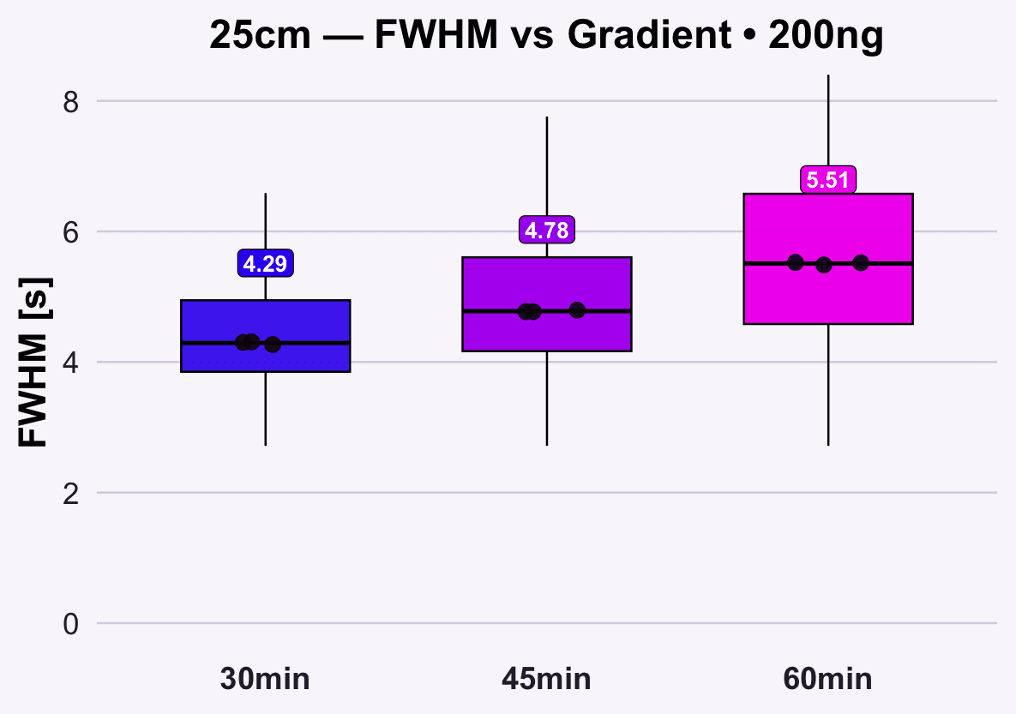
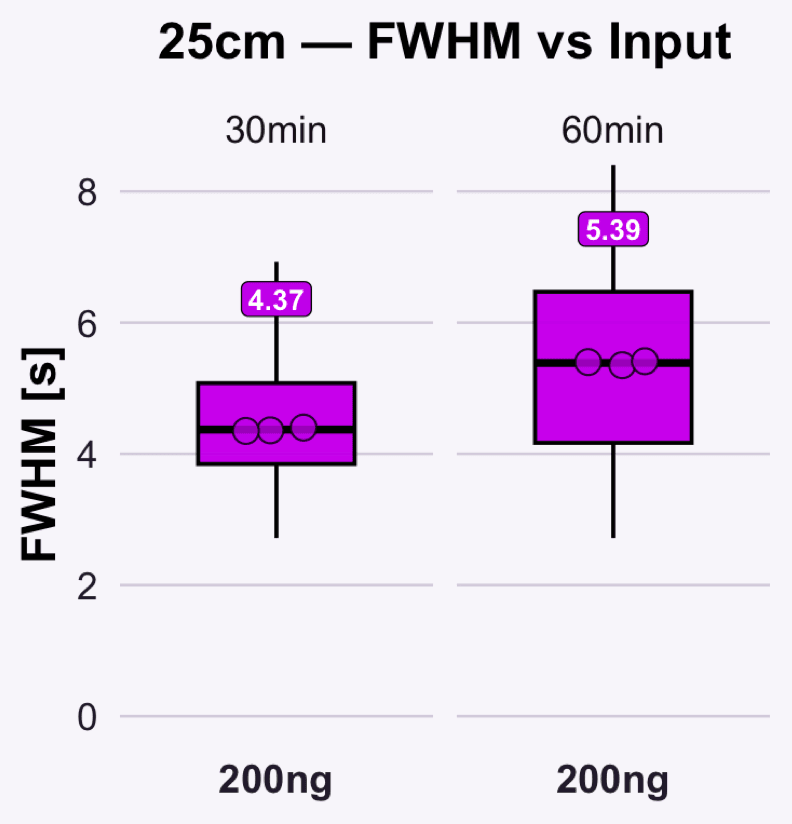
At 400 nL/min, FWHM values of ~4.2–5.5 s across 30–60 min gradients provide the resolving power required for deeper identification and improved precursor separation. The increased column length enhances proteome depth without requiring extreme gradient durations.
Backpressure Flexibility & Workflow Versatility
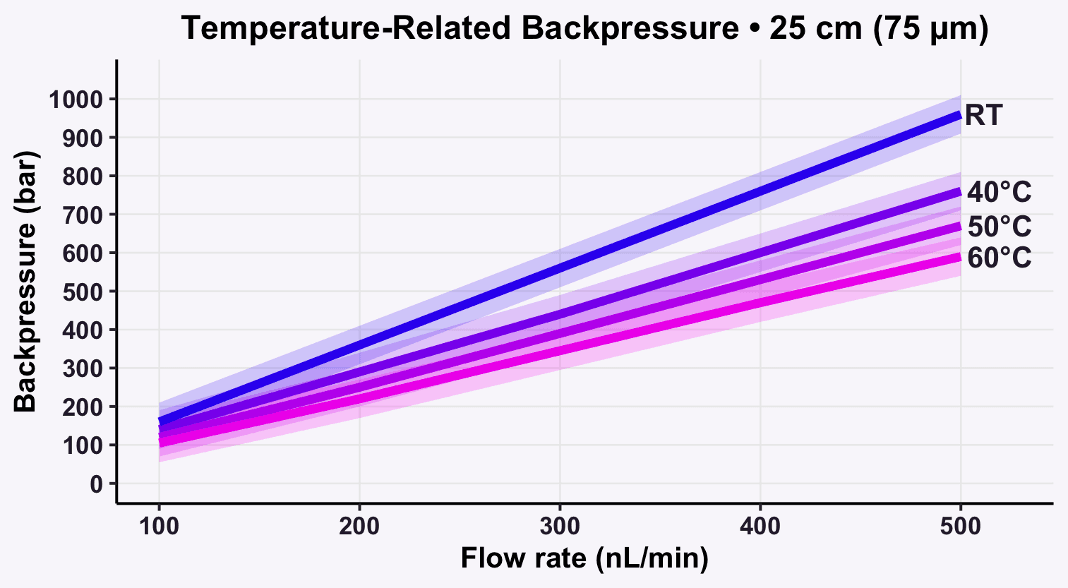
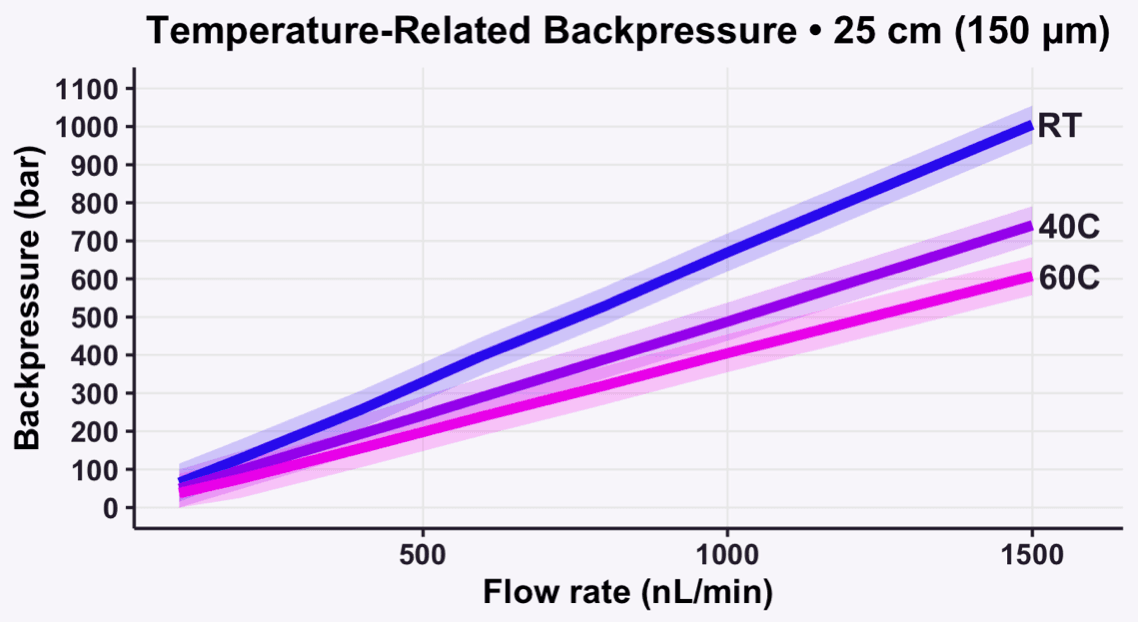
Operating within 100–800 nL/min, the 25 cm format is optimized for high-resolution nanoflow separations where peak capacity is the primary driver of identification depth.
Pressure profiles
Compatibilities
Connect columns feature a pre-installed CaptiveSpray Inlet (CSI) adapter at the emitter end, enabling direct use on Bruker CaptiveSpray and CaptiveSpray Ultra ion sources without additional emitter hardware. At the inlet side, an integrated liquid junction allows straightforward connection to nano-LC systems using standard 10-32 threaded female fittings, enabling fast column exchange and preserving zero-dead-volume performance.
In Bruker configurations, grounding is applied through the liquid junction, ensuring proper electrical contact and stable electrospray operation.
This configuration provides a robust nanospray interface with minimal post-column dispersion, stable spray performance, and seamless integration with Bruker timsTOF platforms.
Compatible Connection Systems
• Thermo Scientific nanoViper Fingertight Fittings • IDEX Health & Science MarvelXACT UHPLC Connection Systems • Waters ZenFit Connection Technology (compatibility pending verification)
Recommended Liquid Junction Options
C18 Bead Specification
Specification Table
| Property | Specification |
|---|---|
| Silica Brand | ReproSil-Pur 120 C18-AQ (Dr. Maisch GmbH) |
| Chromatographic Mode | Reversed-phase |
| Particle Size | 1.9 µm |
| Pore Size | 120 Å |
| Surface Area | 300 m²/g |
Application Notes
Ultra robust performance stability of 25 cm × 75 µm Emitter-Integrated Nanoflow Column with 1.9 µm C18 Material over 800 Measurements
PDF - 1.5 MB
High-Sensitivity and Reproducible DIA Performance of a 15 cm × 75 µm Emitter-Integrated Nanoflow Column on the Orbitrap Astral System
PDF - 1.1 MB